

“Two Flags, One Breeze: Bishop O’Connell Reflects on Faith, Freedom and America at 250”
By Bishop David M. O’Connell, C.M.
Top photo caption: From Bishop O’Connell’s office window at the Diocese of Trenton Chancery, the flags of the United States and the Holy See fly side by side, reflecting the shared journey of faith and freedom. Ryan Larason photo
By: Bishop David M. O’Connell, C.M.
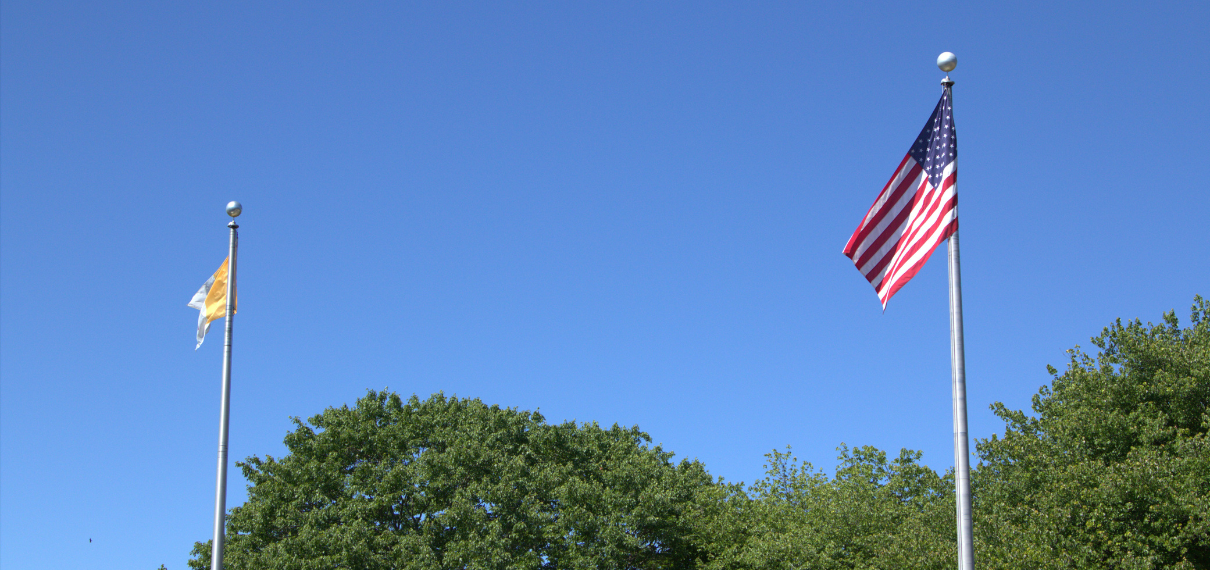
Photo: Ryan Larason
Outside my office window at the chancery, two flags rise and fall together in the same breeze—the “Stars and Stripes” of the United States of America and the yellow-and-white banner of the Holy See. Their colors catch the morning light in different ways, yet they move in a shared rhythm, reminding me that the story of this nation and the history of the Church — although the Church is far more ancient — have long unfolded side by side.
That simple daily sight has often become a quiet meditation for me. The values we celebrate as Americans—liberty, justice, solidarity, and the pursuit of the common good—find deep resonance within the truths of our Catholic faith. As our country marks its 250th anniversary, those two flags prompt and offer an invitation to reflect upon how these ideals have shaped both our national identity and our Christian vocation.
Our nation was born from a bold conviction: that every human being possesses an inherent dignity bestowed not by kings or governments, but by the Creator. This truth, so central to the Declaration of Independence, resonates profoundly with the Church’s teaching on the dignity of the human person.
Catholics have long recognized in America’s founding principles a moral horizon that points beyond politics to something transcendent. Our nation’s founders, imperfect though they were and limited by the blind spots of their times, understood that freedom is not merely the ability to choose but carries with it the responsibility to choose what is right, good, true, and just. For this reason, the Church has consistently affirmed the promise of America—not as a finished achievement, but as an ongoing vocation.
From the earliest days of the republic, Catholics have contributed to the nation’s growth and development. Immigrant families who arrived with little more than hope found in America a place where faith could flourish. They built homes, parishes, schools, hospitals, and charitable institutions that became anchors of community life.
Catholics have served in Congress and on the battlefield, in classrooms and labor unions, in courtrooms and in the quiet corners of parish halls where the hungry were fed and the grieving were consoled. Their witness has reflected the theological virtues: faith that God guides history, hope that tomorrow can be better than today, and charity that sees Christ in every neighbor. These virtues did not make Catholics — or, indeed, Christians and people of faith generally — outsiders to the American story; they made them indispensable contributors to it.
The two flags outside my window remind me each day that our Church and our nation share a common moral vocabulary. Catholic teaching and American ideals meet in several important ways.
We share a commitment to ordered liberty. American freedom is not simply license; at its best, it is ordered toward the common good. This understanding aligns with the Church’s teaching that authentic freedom is found in truth and virtue.
The pledge of “liberty and justice for all” echoes the biblical call to defend the widow, the orphan, and the stranger. Catholic teaching reminds us that justice is not optional; it is a measure of a society’s moral health.
The American ideal of E pluribus unum — “out of many, one”—harmonizes with the Church’s teaching on solidarity, the conviction that we are responsible for one another and bound together in a common humanity.
Likewise, both the American constitutional tradition and Catholic social teaching recognize that society should be ordered toward the common good, enabling all people to flourish. Here, civic responsibility and Christian discipleship — while distinct in their purpose — can reinforce one another.
Anniversaries invite gratitude, but they also invite examination. The United States of America has accomplished much over the past 250 years, yet the work of liberty, justice, peace, and reconciliation remains unfinished.
We give thanks for the blessings of our nation’s history while also acknowledging its failures and injustices. The promise that all people are created equal has not always been extended equally to all. Yet the American story is, in part, the story of continually striving to bring our laws, institutions, and culture into closer alignment with that enduring truth. Gratitude and honesty belong together, for genuine patriotism is strengthened — not diminished — by a willingness to learn from the past.
The Church calls us to confront the wounds that still mark our national life: divisions that fracture communities; economic inequalities that burden families; threats to human life and dignity at every stage, from conception to natural death; the erosion of civil discourse; and the temptation to retreat into fear, resentment, or cynicism.
Yet Catholics do not face these challenges with despair. We face them with the hope born of the Gospel and with confidence that God’s grace can transform hearts, communities, and even nations.
As we look toward the next 250 years, the Church offers a vision rooted in Christ and directed toward the flourishing of all:
• A nation where every human life is cherished and protected, from conception to natural death.
• A society where marriage and families are supported and strengthened.
• A culture where truth is honored and freedom is safeguarded.
• A people committed to peace, justice, and responsible stewardship of creation.
• A country where faith is not pushed to the margins but contributes to the renewal of civic life.
This is not a partisan vision. It is a vision that is deeply Catholic and profoundly American. Indeed. The best of our nation’s ideals and enduring truths of our faith need not stand in opposition; they can and do enrich one another.
As the two flags outside my window continue to rise and fall in the same breeze, they remind me that our nation’s story is still being written. The Church, together with all people of goodwill, has a vital role in shaping its next chapter—through service, through witness, and through prayer for our country and all who call it home.
As we celebrate its 250th anniversary, may God bless the United States of America. May God guide our leaders, protect our people, and strengthen our commitment to the virtues that elevate both our civic life and our life of faith. And may the Holy Spirit inspire us to build a future worthy of the dignity with which our Creator has endowed every human person, so that this nation may continue to be a beacon of hope, liberty, justice, and peace for generations to come. And may Mary, our Immaculate Mother and patroness of America lead us ever more closely to the Sacred Heart of her Son.